
Colorado Springs Domestic Violence FAQs
Frequently Asked Questions About Domestic Violence Charges in Colorado
Do You Have Questions About Domestic Violence Charges?
Being arrested or accused of domestic violence can leave you with many questions.
- Will you go to jail?
- Can you return home?
- What happens if the alleged victim wants to drop the charges?
- Will a domestic violence conviction affect your job or your ability to see your children?
At The Law Office of Jeremy Loew, we help people facing domestic violence allegations in Colorado Springs understand their rights and legal options.
Below are answers to some frequently asked questions about domestic violence charges, arrests, protection orders, and criminal defense in Colorado.
What Is Considered Domestic Violence in Colorado?
Under Colorado law, domestic violence generally involves an act or threatened act of violence against someone with whom the accused has or previously had an intimate relationship.
The definition also includes certain crimes against people or property committed as a means of coercion, control, punishment, intimidation, or revenge against an intimate partner.
Domestic violence is not a separate criminal offense in Colorado. Instead, it is a designation attached to an underlying offense, such as assault, harassment, menacing, or criminal mischief.
Can You Be Arrested for Domestic Violence Without Physical Injuries?
Yes. A domestic violence arrest does not necessarily require visible injuries.
Police may arrest someone when they have probable cause to believe a qualifying domestic violence crime occurred. Threats, harassment, property damage, or other conduct may support criminal charges even when nobody was physically injured.
The specific circumstances and available evidence determine whether an arrest is legally justified.
Are Police Required to Make an Arrest in Colorado Domestic Violence Cases?
Colorado has a mandatory arrest law for domestic violence incidents.
When officers determine that probable cause exists to believe a domestic violence crime occurred, they generally must arrest the suspected offender.
Officers must also consider circumstances such as self-defense, the severity of injuries, and whether one person was the primary aggressor.
An arrest does not mean someone has been proven guilty.
Can the Alleged Victim Drop Domestic Violence Charges?
No. The alleged victim cannot independently dismiss or drop criminal charges.
Once prosecutors become involved, prosecuting authorities decide whether to file, continue, or dismiss criminal charges.
Even if the alleged victim changes their story, withdraws an accusation, or asks for dismissal, prosecutors may continue the case.
However, changes in witness testimony or cooperation can affect the available evidence and the defense strategy.
What Happens After a Domestic Violence Arrest in Colorado Springs?
Following an arrest, the accused may be taken into custody and required to appear before a judge before release.
The court will address bond conditions and explain any mandatory protection order.
The criminal case may then proceed through hearings, evidence review, negotiations, motions, and possibly a trial.
Because decisions made early in the process can affect the case, obtaining legal advice promptly is important.
What Is a Mandatory Protection Order?
A mandatory protection order is a court order issued in criminal proceedings to protect alleged victims and witnesses.
In domestic violence cases, additional restrictions may prohibit contact with the alleged victim, require the accused to leave a shared residence, or impose firearm-related restrictions.
The exact terms depend on the court’s order and the circumstances.
Violating a protection order can lead to additional criminal charges.
Can I Contact My Spouse or Partner After a Domestic Violence Arrest?
That depends on the terms of the protection order.
If the court prohibits contact, you cannot legally call, text, email, visit, or communicate indirectly with the protected person.
Even if your spouse or partner contacts you first, that does not automatically authorize you to respond.
Only the court can modify or remove the restrictions. Your attorney can explain whether requesting a modification is appropriate.
Can I Return Home After Being Charged With Domestic Violence?
Not necessarily.
A protection order may prohibit you from returning to a residence shared with the alleged victim.
This restriction can apply even if you own the home, pay the mortgage, or are named on the lease.
Your attorney may be able to request a modification or arrange a lawful process for retrieving essential personal belongings.
Do not return to a prohibited residence without proper court authorization.
What If I Am Falsely Accused of Domestic Violence?
False or inaccurate accusations can arise from misunderstandings, conflicting accounts, or intentional misrepresentations.
If you believe the allegations are false, preserve relevant evidence, including messages, photographs, recordings, and information about potential witnesses.
Avoid confronting the accuser or attempting to persuade them to change their statement.
A domestic violence defense attorney can investigate the allegations, identify inconsistencies, and present evidence supporting your defense.
Can I Claim Self-Defense in a Domestic Violence Case?
Yes. Self-defense may be available when a person reasonably believes physical force is necessary to protect against unlawful force, subject to Colorado’s legal requirements.
However, claiming self-defense does not automatically result in dismissal.
Your attorney must examine the circumstances, the degree of force used, witness accounts, and other evidence to determine whether the defense applies.
Is Domestic Harassment Considered Domestic Violence?
It can be.
Harassment may receive a domestic violence designation when the alleged conduct meets Colorado’s statutory definition of domestic violence.
Depending on the circumstances, harassment allegations may involve unwanted communications, threats, physical contact, or other prohibited behavior.
Not every argument or unpleasant communication constitutes criminal harassment. The specific conduct and evidence matter.
What Happens If I Violate a Domestic Violence Protection Order?
Violating a protection order can result in a separate criminal charge, even when the underlying domestic violence case remains unresolved.
A violation may also affect bond conditions or lead to additional restrictions.
If you have been accused of violating an order, avoid further contact and speak with a criminal defense attorney about your legal options.
Will I Go to Jail for a Domestic Violence Charge?
Jail is possible, but not every domestic violence case results in incarceration.
The potential penalties depend on the underlying criminal charge, the seriousness of the alleged conduct, prior convictions, and other circumstances.
A conviction may also result in probation, fines, required treatment, and other court-ordered conditions.
An attorney can explain the potential penalties associated with your particular charges.
Will I Have to Attend Domestic Violence Classes?
A person convicted of an offense involving domestic violence may be required to complete a court-approved domestic violence treatment program.
Treatment requirements depend on the conviction, sentencing circumstances, and applicable Colorado law.
These programs can involve assessments, counseling, monitoring, and ongoing participation.
Failure to comply with required treatment can result in additional legal consequences.
Can Domestic Violence Charges Affect Child Custody?
Yes. Domestic violence allegations and convictions can affect parenting responsibilities, parenting time, and related family court proceedings.
A criminal protection order may also restrict contact with children, depending on its terms.
Criminal and family court orders can create complicated situations. It is important to understand and follow every applicable court order.
Can Domestic Violence Charges Affect Military Personnel?
Yes. Military service members stationed in or around Colorado Springs may face consequences beyond the civilian criminal justice system.
Depending on the circumstances, a domestic violence allegation or conviction may affect security clearances, military duties, firearm eligibility, promotions, or continued service.
Military personnel should obtain military – specific legal advice that considers both civilian criminal proceedings and potential military consequences.
Can a Domestic Violence Charge Be Removed From My Criminal Record?
Possibly, depending on the outcome of the case and applicable Colorado record-sealing laws.
Some dismissed cases and qualifying criminal records may be eligible for sealing. However, eligibility varies, and domestic violence-related convictions can present additional restrictions.
An attorney can review your record and determine whether sealing may be available.
Do I Need an Attorney for a Domestic Violence Charge?
Although you may represent yourself, domestic violence cases can involve complicated legal issues and serious consequences.
An experienced attorney can investigate the allegations, review police reports and witness statements, challenge questionable evidence, explain protection orders, negotiate with prosecutors, and represent you in court.
Having an experienced criminal defense attorney can help you make informed decisions and protect your legal rights.
Speak With a Colorado Springs Domestic Violence Defense Attorney
If you have been accused of domestic violence, understanding your rights is an important first step.
The Law Office of Jeremy Loew represents people facing domestic violence charges in Colorado Springs and surrounding communities.
Whether you are dealing with an arrest, a protection order, or allegations you believe are false, we can evaluate your situation and explain your legal options.
Contact The Law Office of Jeremy Loew at (719) 387-4111 today for a free consultation.
How Can We Help?

“Jeremy was exceptional on my case. Clear, knowledgeable and thorough. He directed me through complex court proceedings and helped me understand the process. He acts with utter professionalism at all times and made me feel safe. His paralegal Katey is also incredible. She is organised, responds rapidly to questions, thorough and ensures you have everything you need as a client. Through firm acts with utter integrity and I would recommend them to anyone experiencing legal issues or feeling disempowered through the legal process.” -Holly Raimundi
“I had a wonderful experience with Jeremy Loew’s office! Matt, Jeremy, and Katey were all a pleasure to work with and money well spent. My cases were dismissed and sealed in the end and I couldn’t be more happy with how they showed up and fought for me in the courtroom. Thankyou so much! I would definitely recommend to hire this lawyer, you won’t be disappointed.” – Araysha Marie
Colorado Springs Criminal Attorney & DUI Lawyer Jeremy Loew
“Jeremy Loew is awesome, he covered my case and was immediately on it. So much stress off my shoulders, he gave me a clear cut pathway for me to follow and helped me out so much more than I am able to express.” – Aaron Mortensen
“I couldn’t be more grateful for Jeremy Loew and how he handled my case. I was facing a reckless driving charge and a pretty serious speeding ticket, so after looking up some of the best lawyers in Colorado Springs, I decided to go with Jeremy.
He called me back within minutes, told me I had nothing to worry about, and explained everything I needed to know. This was my second ticket within a year, so I was pretty nervous, but Jeremy made sure everything was taken care of.
When I went to court, Jeremy was able to get me 0 points on my license and made sure I paid as little as possible. I honestly couldn’t have asked for a better outcome. If I ever need a lawyer again, I’ll definitely be contacting Jeremy Loew. I highly recommend him!” – Lilly
Military Members & Domestic Violence Defense in Colorado Springs
Colorado Springs has a large military population, and domestic violence charges can have additional consequences for service members.
Additional charges may include:
- Command involvement
- Security clearance issues
- Administrative separation
- Potential court-martial proceedings under the UCMJ
If you are active duty or affiliated with the military, your defense strategy must account for both civilian and military implications.
Defense Strategies in Domestic Violence Cases
Every case is different, but common defense approaches may include:
- Challenging the credibility of allegations
- Demonstrating lack of evidence
- Establishing self-defense
- Identifying inconsistencies in statements
- Reviewing body camera footage and witness testimony
- Examining motives behind false accusations
A detailed review of the facts is essential in building an effective defense.
Domestic Violence and Alcohol-Related Charge
Some domestic violence cases involve alcohol, which can complicate matters further.
Charges such as DUI or DWAI may arise from and be related to the same incident.
This overlap can increase penalties and requires a coordinated defense strategy that addresses both issues.

The Law Office Of Jeremy Loew
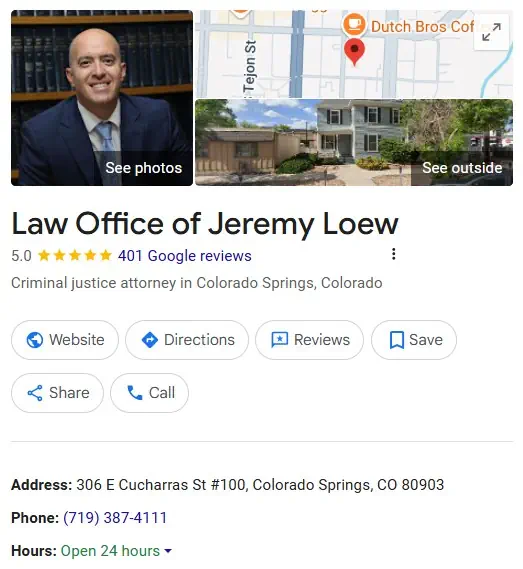
306 E Cucharras St #100, Colorado Springs, CO 80903
(719) 387-4111 | Contact us now for your Free Consultation.
Serving Colorado Springs, Peyton, Rush, Security, Widefield, Manitou, Broadmoor, Black Forest, Northgate.

Attorney Advertising Disclaimer: This website is provided by The Law Office of Jeremy Loew for general informational purposes only and does not constitute legal advice. Contacting our office through this website does not establish an attorney-client relationship. Every legal matter is unique, and past case results do not guarantee similar outcomes in future cases.